Coupons
Discount codes you fund yourself, with the figures that say whether they earned their keep.
Restaurant → Coupons
Codes, their rules and how often each has been redeemed.
Yours, not the platform's
A coupon here is your discount, off your margin, valid at your restaurant. Your platform runs its own separately — see Deals. Keeping them apart is what stops your offer costing them, or theirs costing you.
Creating one
| Field | Notes |
|---|---|
| Code | What the customer types. Must be unique — a duplicate is refused. Short and memorable beats clever. |
| Title and description | What it is, for your own list. |
| Type and value | A percentage off, or an amount off. |
| Minimum order | Below this the code is refused. |
| Total uses | The cap across everybody. Blank is unlimited. |
| Uses per customer | How many times one person may use it. |
| Starts and ends | The window. Either can be left open — the list shows Always on when both are. |
| Active | Off stops it working without deleting it or its history. |
The figures
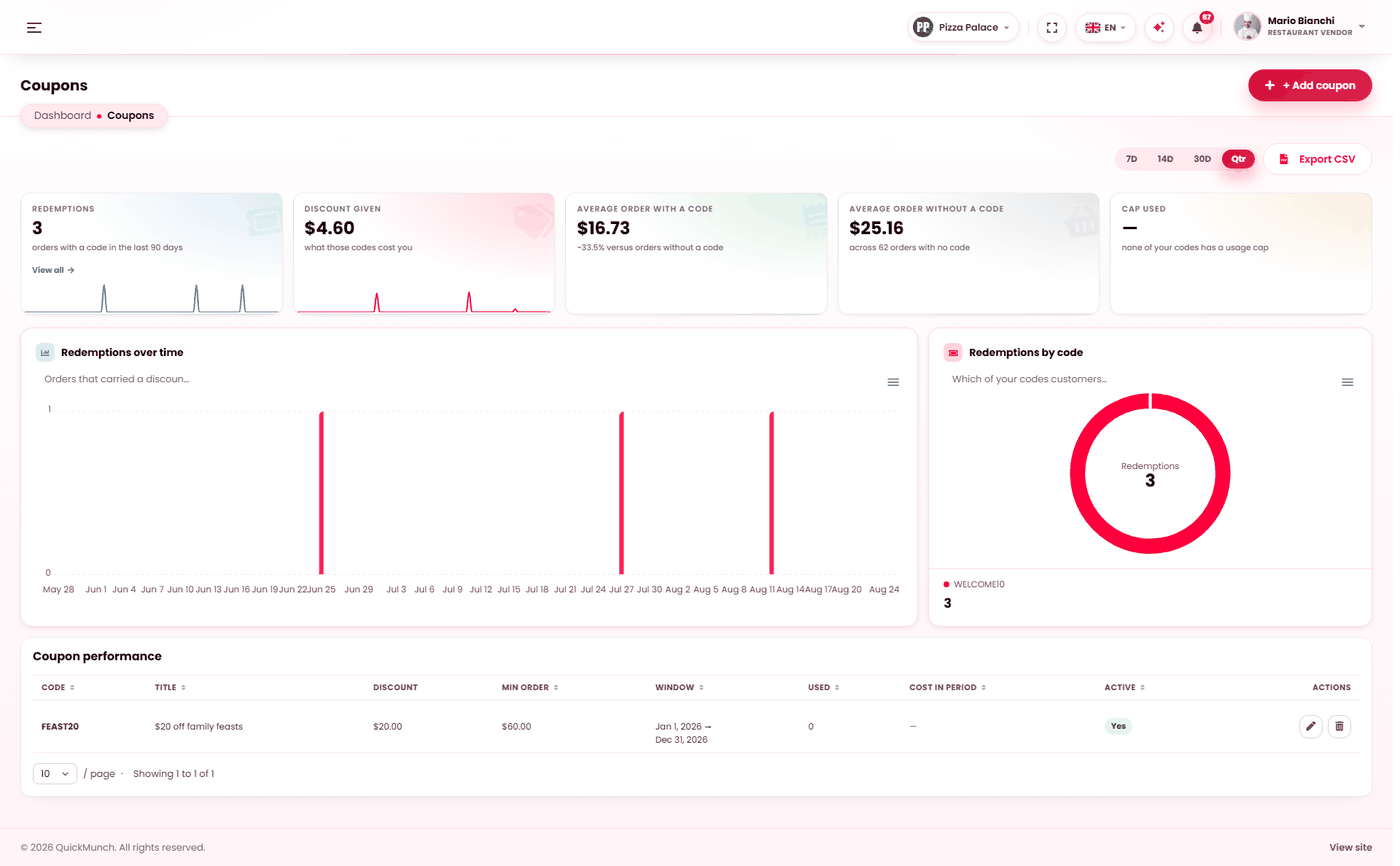
Across the top, over a period you choose:
| Figure | Meaning |
|---|---|
| Redemptions | Orders that carried a code. |
| Discount given | What those codes cost you. The real number. |
| Average order with a code | What the basket looked like when one was used, with the lift against orders without. |
| Average order without a code | Your baseline, across how many orders. |
| Cap used | How much of your capped allowance has gone. |
The lift is the whole question
Compare the two averages. If baskets with a code are larger, the coupon is making people spend more and it is working. If they are the same or smaller, you are discounting orders that were going to happen anyway — which is a cost with no return, however many redemptions it racked up.
The charts and the table
- Redemptions over time — day by day. Shows whether a campaign had a life beyond its first week.
- Redemptions by code — which of your codes people actually use. Usually fewer than you have.
- Coupon performance — per code, including cost in period. Sort by it and the expensive ones are named.
Deleted codes still appear in the history, marked as such, so a past month's figures stay readable.
When it doesn't work
A customer says the code is refused
In order: is it active, is it inside its window, has the total cap been reached, has that customer used their allowance, and does the basket meet the minimum?
A code cannot be saved
That code is already in use. Codes are unique.
The discount cost more than expected
Check the minimum order. A percentage off with no minimum applies to a small order as readily as a large one, and the small ones are where your margin is thinnest.
Nobody is using any of them
Nothing is telling customers the codes exist. A coupon is a marketing message with a code attached, not a code on its own.