Loyalty
Your reward catalogue, the give-back rate that says what it costs you, and the adjustment that fixes a mistake.
Restaurant → Loyalty & rewards
Points earned per order, what they are worth, and how rewards redeem.
Two places, two jobs
| Screen | Sets |
|---|---|
| Settings → Loyalty | Whether you take part, where the programme runs — website, POS, kiosk — and how fast points are earned. |
| Loyalty & rewards | What those points can be spent on, and what it is costing you. |
This page is the second. It is worth doing the first one first — a catalogue with no earn rate behind it gives customers nothing to spend.
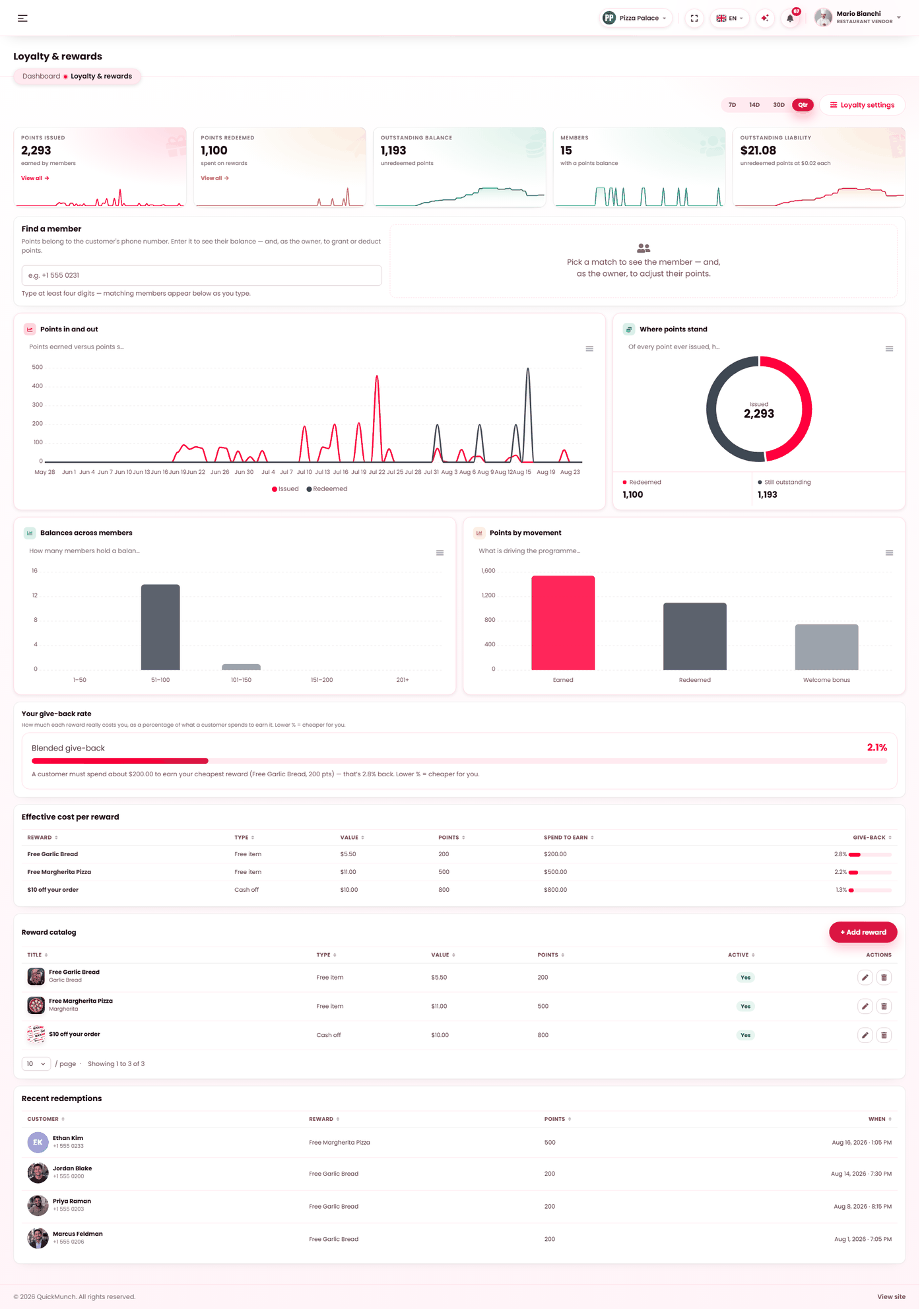
The four figures
| Figure | Meaning |
|---|---|
| Points issued | Earned by members. |
| Points redeemed | Spent on rewards. |
| Outstanding balance | Issued and not yet spent. |
| Members | How many have a balance with you. |
The give-back rate
The meter, and the table beneath it, answer the question that matters: what does a reward actually cost you?
| Column | Meaning |
|---|---|
| Reward | What the customer gets. |
| Points | What it costs them. |
| Spend to earn | How much a customer must spend to reach it. |
| Give-back | The reward's value as a share of that spend. This is your real discount rate. |
So a free dessert worth 6 at 600 points, where 600 points takes 300 of spending, is a 2% give-back. That is the number to compare against your margin — not the points figure, which means nothing on its own.
The meter is empty until you add a reward, because there is nothing to rate.
Building the catalogue
+ Add reward, and choose one of two kinds:
| Kind | Set | Notes |
|---|---|---|
| Free item | A dish from your own menu, and its points cost. | Costs you the dish's cost, not its price — usually the better deal for both sides. |
| Cash off | A cash value, and its points cost. | Costs you the full amount. Simpler to understand, dearer to give. |
Rewards carry a sort order, so the one you want redeemed can lead. A free-item reward must point at a dish on your menu; the screen refuses anything else.
Recent redemptions
What has actually been claimed. Worth reading occasionally: a reward nobody redeems is priced too high, and one redeemed constantly is priced too low.
Finding a member
Points belong to a phone number. Directly under the figures, start typing a customer's number — the whole number or just its ending. From the fourth digit, the members it matches list under the box as you type, each with their name, phone, email and points. A number nobody at your restaurant holds says so. Click a member and they open on the right: phone, email, balance, lifetime points and join date.
Adjusting a balance
Owners also get the adjust fields under the member they opened: enter points as a positive or negative number, optionally a reason, and apply. It asks for confirmation, records an adjustment so the ledger explains itself, and the balance updates right there — no page reload.
Use it for the honest cases — a customer whose points did not register, a goodwill gesture after a bad meal.
When it doesn't work
Customers are not earning points
Five things must all be true: loyalty is on for the platform, your restaurant has opted in under Settings → Loyalty, the channel the order came through is switched on there (website, POS or kiosk), the customer has an account, and that account has a phone number. Website guests earn nothing, and neither does an account with no number — points are keyed to it; the checkout and the customer's My rewards page both say so, with a link to add one. At the till and the kiosk the number given with the order is enough: the order is placed for the member it names.
Nobody redeems anything
The points cost is too high for what people actually spend. Read the spend to earn column — if it says 400 and your average order is 25, that is sixteen visits for one dessert.
Outstanding points keep climbing
Either the earn rate is too generous, or nothing in the catalogue is worth claiming. Both show up here before they show up in your margin.
A reward cannot be saved
A free-item reward needs a dish from your own menu; a cash reward needs a value above zero.