Reviews
Moderating what customers said about your restaurants — two states, four actions, and a line worth holding.
Admin → Reviews
Reviews awaiting moderation, and those already published.
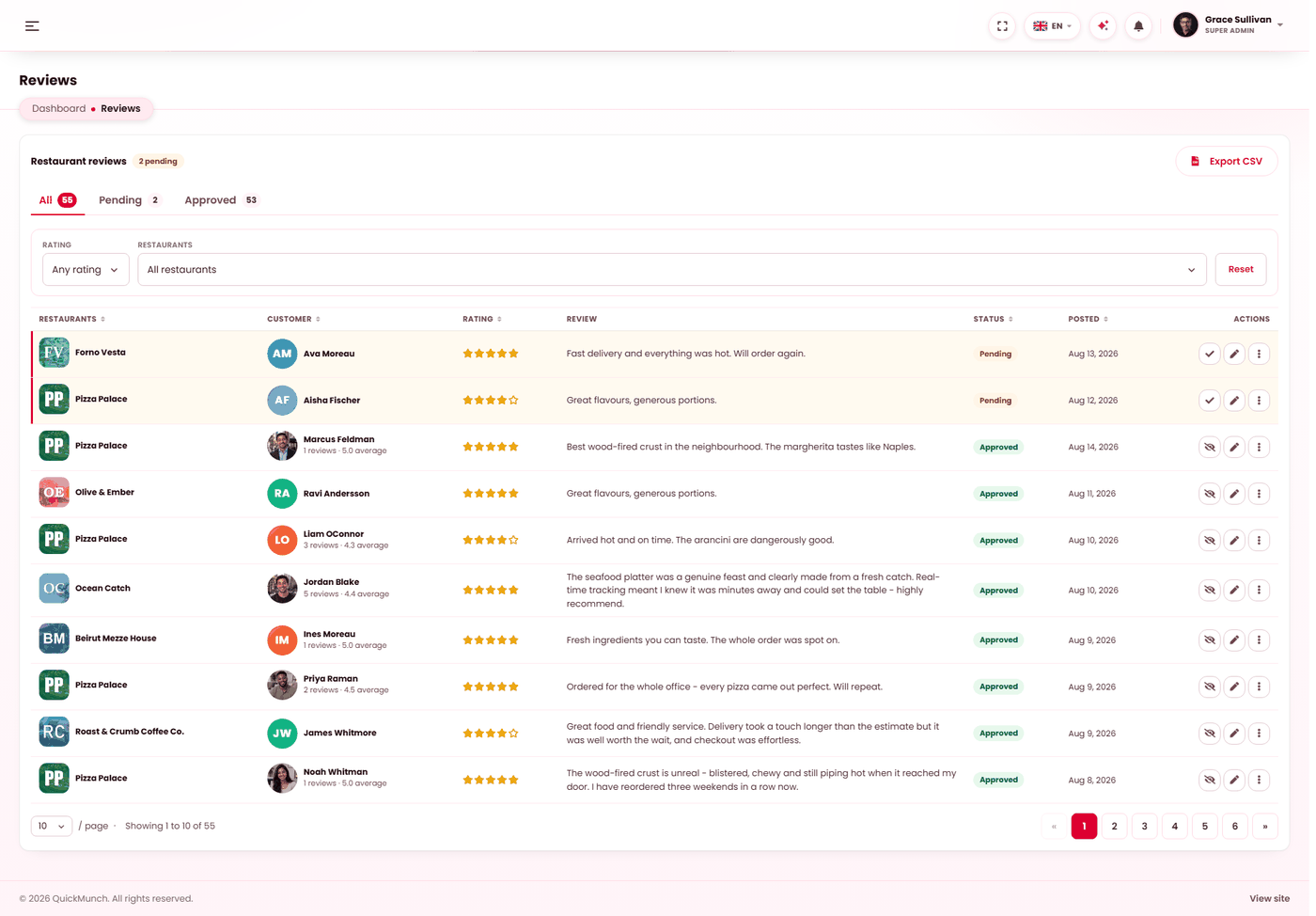
Two states, not three
| Status | Meaning |
|---|---|
| Pending | Not visible on the storefront and not counted in the rating. |
| Approved | Live on the restaurant's page and counted in its rating. |
Hide is not a third state — it puts an approved review back to pending. So hiding is always reversible, which is why it is the safer action in nearly every case.
The filters
| Filter | Narrows to |
|---|---|
| Status | Pending or approved. Pending is the moderation queue. |
| Rating | One star value. Filtering to one star is how you find what needs attention first. |
| Restaurant | One venue — when an owner is disputing something. |
Export CSV writes what the filters match.
The four actions
| Action | What happens |
|---|---|
| Approve | Appears publicly and counts towards the rating. |
| Hide | Back to pending. Kept, reversible, off the storefront. |
| Edit | Change the rating or the text. Use sparingly — see below. |
| Delete | Permanent. The restaurant's rating is recalculated, and the dialog says so. |
Reading the author
Each review shows the author's history — how many they have left and their average. A reviewer is flagged Consistently low ratings when their pattern is uniformly negative.
That flag is context, not a verdict. It is the difference between "this restaurant had a bad night" and "this person rates everywhere one star", and it is worth knowing before you telephone an owner who is upset.
Deciding what to hide
A line worth holding: hide what breaks your rules, not what hurts a restaurant's feelings.
- Hide — abuse, personal data, spam, a review of the wrong restaurant, or something plainly not about the food.
- Leave — a bad experience honestly described. Restaurants will ask you to remove these; a platform that does has no credible ratings.
Ratings follow approval
A restaurant's star rating is worked out from approved reviews only. Hiding one changes their average — which is why hiding on request rather than on policy quietly turns your ratings into fiction.
Where reviews come from
Only from a customer's completed order, in their account. Nobody can review a restaurant they have not ordered from, which is what makes the ratings worth something — see Reviews (customer).
When it doesn't work
A restaurant's rating changed on its own
A review was approved, hidden or deleted. The average is recalculated from what is visible.
A review names a deleted restaurant
The review outlives the venue and is shown with the restaurant marked deleted, so the record still makes sense. Delete it if it no longer serves a purpose.
A restaurant says it gets no reviews
Check how many of their orders are actually marked complete. The prompt only exists on completed orders, and that is usually the whole explanation.
An owner is demanding a review be removed
Apply your published rule and say which part of it applies, or does not. "It is negative" is not one of the reasons, and saying so once is easier than saying it every month.